Skip to content

Shopkeeper safety guide

Fake payment screenshot fraud

A customer shows a screen that looks like payment done. You hand over goods. The money never came. Before anything leaves your counter, verify the credit in your own UPI or bank app.

Quick answer

Fake payment screenshot fraud is when someone shows an edited, reused, or unrelated payment-success image instead of paying. It is the most common pattern in Toolsda’s illustrative report snapshot (73% of 127 hand-picked anonymized reports, average loss Rs 3,400). Stop it with one habit: release goods only after the credit appears in your own UPI or bank app — a screenshot alone is never proof.

What it is

The scam in one sentence

Fake payment screenshot fraud is when a person shows a screen that appears to confirm a UPI payment — a PhonePe or GPay success tick — but the seller’s account was never credited. The seller trusts that screen and releases goods. The screenshot is not the transaction record — your account history is.

Source note: the 73% / Rs 3,400 figures on this page come from Toolsda’s L3 community-report snapshot — an illustrative, hand-picked baseline, not a national incidence rate and not an accusation about any person or UPI ID. Official totals live separately below.

How it works, step by step

Sixty seconds at rush hour

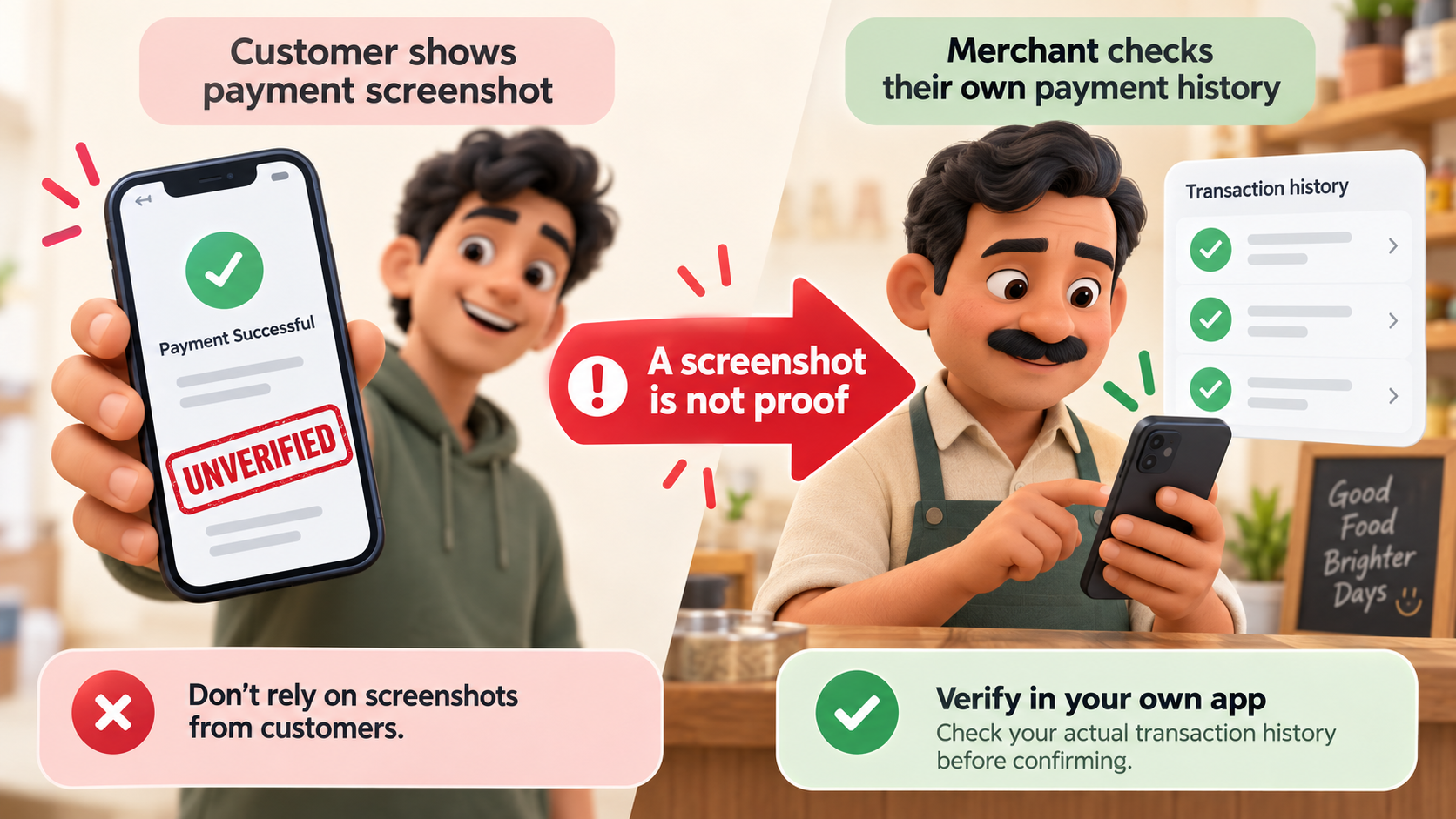
Educational illustration contrasting an unverified customer payment screenshot with a merchant checking their own payment history
Educational illustration. The payment record that matters is the credit visible in the seller’s own UPI or bank account.
  1. STEP 1

    A sale is made

    A busy counter — for example, groceries worth Rs 5,000 at 7:42pm. The customer is ready to collect.

  2. STEP 2

    A “success” image appears

    It may be an old image, an edited one, or a payment to somebody else entirely.

  3. STEP 3

    Pressure replaces verification

    “See, done — I have a bus.” The seller is asked to hurry and trust the screen.

  4. STEP 4

    Goods leave, money never comes

    The evening check shows no credit, no SMS, no reference. The loss lands at closing time.

Experience · E-E-A-T

How people get cheated at the counter

Three illustrative scenarios drawn from commonly reported patterns. They are teaching examples — not verified incidents, not accusations against anyone.

Kirana shop, evening rush

Rice, oil, and a “success” tick

A customer in a hurry shows a payment-app tick for the week’s groceries and leaves with the bags. At closing, the account shows no credit for that sale — and the same person had tried the neighbouring shop earlier.

Medical shop

The beep came from the wrong phone

A payment sound plays — but from the customer’s second phone, not the shop’s device. Medicines change hands on the strength of that sound. The shop’s own app never recorded a credit.

Food stall, student crowd

Three orders, one trick, ten minutes

A group orders in quick succession, each showing a screenshot at a busy moment. None of the three payments arrive. Speed and crowding did the work — no verification happened between orders.

Official data · L1 / L2 / L3 separated

What RBI, Parliament, and NPCI say

Three layers, never merged into one score. L1 is authoritative but lagging; L2 is what regulators say right now; L3 is Toolsda’s own pattern snapshot.

L1 — Official incidence (authoritative, lagging)

  • 36,075 bank frauds worth Rs 13,930 cr (2023-24, RBI Annual Report 2023-24) — all bank-fraud categories, not UPI alone.
  • 13.42 lakh UPI frauds worth Rs 1,087 cr (2023-24, Lok Sabha Unstarred Q211 — Ministry of Finance, answered 25 Nov 2024) — UPI-specific.
  • 172 billion UPI transactions with a fraud rate of 0.0007% (2024) — ecosystem scale, not a fraud count.
Full L1 statistics

L2 — What regulators say right now

  • NPCI has been discontinuing person-to-person collect requests to curb fraud via misleading payment demands.
  • Regulators require device binding, two-factor authentication, and daily transaction limits on UPI apps.
  • Cyber-crime advisories ask users to save screenshots and chats for law-enforcement investigation — and to report through 1930.
Live L2 advisories

L3 — Toolsda’s pattern snapshot (attention only)

In the current illustrative snapshot, fake payment screenshots are the largest pattern (73% of 127 hand-picked anonymized reports, average loss Rs 3,400 — e.g. bangalore kirana, Rs 5,000, 7:42pm rush hour). That is an attention signal for shopkeepers, not a national rate and not an accusation about any person or UPI ID.

New · live tracking

Live media coverage of this fraud type

An AI-assisted feed of public news coverage mentioning fake-payment-screenshot fraud, refreshed automatically. This tracks attention, not incidence — see L1 above for official numbers.

Live coverage status

Collecting

No media coverage collected for this type yet. Check back soon, or see the live tracker.

Media coverage only — attention, not incidence. See official incidence (L1).

Recent coverage

No media coverage collected for this type yet.

Five red flags — the 3-second check

No confirmation on YOUR phone

A real incoming payment notifies your own phone or sound box. A success screen that exists only on the customer’s phone is not proof.

Your balance did not increase

Open your own UPI or bank app and check. The seller’s account record decides — never the buyer’s screen.

No bank SMS with a transaction reference

A genuine credit comes with your bank’s own message and reference. An image with no reference, an old date, or a blurred amount field deserves a pause.

They pressure you to hurry

Rush-hour urgency — “I have a bus”, a crowd at the counter — is a reason to slow the handover, not to skip verification.

They ask you to scan, approve, or enter a PIN

A UPI PIN sends money; it is never needed to receive money. Any such instruction is itself the scam.

The rule behind all five: Wait for your bank SMS beep. Check balance. A screenshot can be made in 10 seconds on any phone.

Verify before you hand over goods

  1. 1

    Wait for YOUR phone to confirm

    Give it about 10 seconds. A real payment notifies your own phone or sound box — a screen on the customer’s phone proves nothing.

  2. 2

    Open YOUR app and check the balance

    On your own phone, confirm the amount was credited before releasing goods or services.

  3. 3

    Match the transaction reference

    Where a reference is shown, compare it with the credit in your own account history.

Notifications and sound boxes can be useful prompts, but your UPI or bank transaction history is the final check. If the entry is delayed or unclear, wait rather than relying on a screenshot.

Money already gone? First-hour steps

Act promptly, keep the original evidence, and use only official support channels. Reporting quickly does not guarantee recovery, but it gives your bank and law enforcement the clearest record to act on.

0–10 min

Stop and document

Do not alter the screenshot. Note the time, amount, UPI ID, order or bill number, and any description of the person. Preserve CCTV if available.

10–30 min

Contact your bank or UPI app

Report the missing credit through the official app or bank website. Do not trust phone numbers sent by the buyer.

30–60 min

Report cyber fraud

Call 1930 and file a report at cybercrime.gov.in with the evidence you saved.

Keep

Make an evidence pack

Store the image, chats, receipt, CCTV reference, and complaint acknowledgement in one place.

Prevention routine

A shop-counter checklist

1

Make account verification the final step

Set a simple rule: goods leave only after the credit appears in your own app.

2

Keep a second way to check

If the UPI app is slow, use your bank app or account history instead of relying on the buyer’s screen.

3

Use payment alerts as a prompt, not proof

A sound box or notification can draw your attention, but confirm the transaction record when anything looks unusual.

4

Pause on PIN or QR instructions

Do not scan a customer’s QR code, approve an unfamiliar request, or enter a UPI PIN to “receive” money.

5

Train anyone at the counter

Make sure family members and staff know the same check before releasing goods.

6

Keep evidence sources available

Retain bills and CCTV in line with your normal policy so an incident can be documented accurately.

Tip: use your browser’s print-to-PDF to pin this checklist near the counter.

Questions people ask

How do scammers make fake UPI payment screenshots in 10 seconds?
The important safety point is that a payment-success image can be altered, reused, or shown from an unrelated transaction. We do not provide instructions for making one. Treat every screenshot as unverified and check the expected credit in your own UPI or bank app before releasing goods.
How can I verify whether a UPI payment screenshot is real or fake?
Do not try to decide from the screenshot alone. Open your own UPI or bank transaction history and confirm that the expected credit is present. Match the amount, payer details where your app shows them, and transaction reference where available. The seller’s account record is the proof, not the customer’s screen.
What is the average loss in fake screenshot fraud?
There is no single official national average for this specific scam type. Toolsda’s current anonymised community-report taxonomy shows an illustrative average loss of Rs 3,400 for its fake-screenshot pattern; it is not an RBI or NPCI national estimate. A loss can be smaller or much larger, so verification should happen for every amount.
Can I get money back after fake screenshot fraud?
Recovery is not guaranteed. Save the screenshot, bill, chat, CCTV footage if available, time, amount, UPI ID, and any transaction reference shown. Contact your bank or payment app only through its official support channel, then report cyber fraud promptly through 1930 or cybercrime.gov.in. Fast, accurate reporting can help the investigation and the bank’s review.
Is a PhonePe or GPay screenshot proof of payment?
No. A screenshot only shows what was displayed on another device and can be old, altered, or unrelated to your sale. A payment is verified only when the credit appears in your own UPI or bank transaction history.
What time does fake screenshot fraud happen most?
There is no official nationwide hour-by-hour dataset for this fraud pattern. Toolsda’s local community-report snapshot has identified busy periods as a context worth watching, but it is not a national rate. The safe routine is the same at every hour: confirm the credit in your own account before handing over goods.
Do sound boxes prevent fake screenshot fraud?
A sound box can prompt a seller to notice an incoming payment, but it is not a substitute for checking the transaction record when anything is unclear. Keep the device linked to your own account and verify a credit in your app or bank history before releasing goods.
Can a fraudster play a fake payment sound from a second phone?
A sound heard from a customer’s phone or another device is not proof that your account was credited. Use sound only as a prompt, then check your own UPI or bank transaction history. If the credit is absent or delayed, wait rather than handing over goods.
What is a UTR number and why is it important?
A UTR or transaction reference is an identifier used to trace a payment. It can help a bank or payment app investigate a reported transaction, but seeing a number on a screenshot does not prove that you received money. Compare it with the credit shown in your own account history.
Where can I report a fake UPI screenshot fraud officially?
Report the missing payment to your bank or UPI app through its official support channel. You can also report cyber fraud through the Government of India’s 1930 helpline and the National Cyber Crime Reporting Portal at cybercrime.gov.in. Preserve the original evidence and avoid paying anyone who promises guaranteed recovery.
Sources and scope

This is an educational prevention guide, not legal, banking, or recovery advice. For current official guidance, use NPCI, RBI, your bank, and the Government of India cybercrime reporting service.

Toolsda never asks for money to recover fraud losses. There is no recovery agent — call 1930 or use cybercrime.gov.in only.

Go deeper in the UPI Fraud Centre